Sunday, February 1, 2026

21 Gun Salute: The History and Meaning of a Military Tradition


During a Memorial Day ceremony held at the Presidio of Monterey, members of a firing squad give a 21-gun salute for service members who paid the ultimate sacrifice.

Military.com | By Tiffini Theisen, Published March 13, 2025

 The 21-gun salute is one of the highest military honors, performed for dignitaries, heads of state and fallen service members. But what exactly is it? And why 21 shots?

What Is the 21-Gun Salute?

In military tradition, "guns" refer to artillery or cannons, not rifles. Some believe this practice dates to the Roman era, while others credit it to early European warfare. Either way, it's a solemn tradition with deep roots.

It's different from the "three-volley salute" seen at military funerals, where a rifle party fires three rounds in succession. The three-volley salute originates from battlefield customs when both sides would pause fighting to clear the dead and wounded before resuming combat.

Why Is It Called a 21-Gun Salute?

Why 21 shots and not, say, 20 or 22? The answer lies in centuries-old naval customs. In the early days of gunpowder warfare, warships would fire their cannons to show they had no hostile intent. A ship armed with seven cannons would fire all at once, and forts on land -- where gunpowder was more plentiful -- would respond with three shots for every cannon, totaling 21. Over time, this became the gold standard for honoring heads of state and military leaders.

One historic anecdote comes from the British Royal Navy. In the 17th century, ships fired seven guns because the number aligned with celestial bodies known at the time. Some sailors believed this kept them in harmony with the cosmos. Whether superstition or strategy, the number stuck.

The Different Types of Military Gun Salutes

The 21-gun version may be the most famous of these salutes, but it's far from the only one. The number of shots fired depends on the rank and occasion. Here's a quick breakdown:

·         21-gun salute: Reserved for heads of state, U.S. presidents and foreign dignitaries

·         19-gun salute: Given to vice presidents, prime ministers and certain other high-ranking officials such as the secretary of defense

·         17-gun salute: For four-star generals and admirals

·         15-gun salute: For three-star generals and admirals

·         13-gun salute: For two-star generals and admirals

·         11-gun salute: For one-star generals and admirals

Although 21 represents the highest possible honor, a tale has been told of President Andrew Jackson receiving two 24-gun salutes when visiting the USS Delaware in 1833, perhaps to one-up his predecessors. Whether true or not, it speaks to the pride and spectacle of these ceremonies.

The Origins and History of the 21-Gun Salute

As we've seen, gun salutes trace their roots to early naval traditions.

"Salute by cannon or artillery is a military tradition that originated in the 14th century," according to the Arlington National Cemetery. "The British navy developed the custom of a seven-gun salute because naval vessels typically had seven guns (and possibly also due to the number seven's Biblical and mystical significance)."

Read Next: Burial in Arlington National Cemetery

As gunpowder weaponry advanced, the custom evolved into a formalized military honor. Britain adopted the 21-gun salute by the early 1700s.

In 1818, U.S. Naval Regulations were the first written instructions on the 21-gun salute, outlining the procedures for a presidential visit aboard a ship, according to the U.S. Navy.

In 1875, the United States formally adopted the 21-gun salute, the same number used by Britain, France and other nations.

When Is a 21-Gun Salute Performed?

A 21-gun salute is typically reserved for solemn and significant occasions, such as:

·         Presidential and state funerals

·         Holidays such as Memorial Day and Independence Day

·         Visits by foreign dignitaries and members of a reigning royal family

·         The inauguration of a U.S. president

·         To honor former presidents

A 1935 account of such a ceremony paints a picture of the celebratory mood of a 21-gun salute. The occasion was a visit by President Franklin D. Roosevelt to Charleston, South Carolina, where he disembarked from the USS Houston.

"Big Guns Roar Out 21-Gun Salutes," blared part of a headline in The Charlotte Observer newspaper. 

Four such salutes were fired in Roosevelt's honor that October day. One of them was from the ship, and another from the navy yard. "As the smoke faded over the cruiser's bow, the ship band played first 'The Star Spangled Banner' and then lapsed informally into 'Auld Lang Syne.'"

The 21-Gun Salute Today

In modern times, the 21-gun salute is also fired at noon "on George Washington's birthday, President's Day, Memorial Day [and] Independence Day," according to the Arlington National Cemetery.

The Presidential Salute Battery (PSB), part of the U.S. Army, serves under The Old Guard, or The Headquarters and Headquarters Company (HHC) of the 1st Battalion, 3d U.S. Infantry Regiment. It is in charge of gun salutes conducted by the Army, in addition to military honors, funerals and other ceremonial duties in the National Capital Region (NCR).

Under the U.S. Navy, tradition dictates odd-numbered gun salutes (e.g., 5, 7, 11) for various ranks, with 21 being the highest. The Navy has historically used a 21-gun salute to honor heads of state and high-ranking officers.

When it comes to gun salutes, some historic enthusiasts thought the more, the better. In the summer of 1885, supporters of John A. Logan -- a U.S. senator from Illinois and a prominent Union general during the Civil War -- wanted to arrange a 103-gun salute for his visit to Washington, D.C. However, district officials didn't share their enthusiasm. They nixed any salute within city limits that exceeded the standard 21 guns.

Read More: Military Funeral Honors

The first recorded use of a 21-gun salute for a U.S. president was at George Washington's funeral in 1799. However, it wasn't until later that it became the official standard. Troops honor service members during Memorial Day

Execution of the 21-Gun Salute

The ceremony follows strict guidelines:

·         Cannons or artillery pieces fire at five-second intervals.

·         The salute is typically conducted by an honor guard from all military branches.

·         Safety protocols ensure blank rounds are used and that the firing area is secured.

During a presidential funeral, the 21-gun salute is followed by taps, the solemn bugle call signaling the end of the day. Taps is played after the salute, creating a reflective moment.

The Indiana National Guard supported the 152nd Crown Hill Memorial Service, May 30, 2022, at the Crown Hill Cemetery in Indianapolis. The ceremony included keynote speaker, retired Marine Cpl. Josh Bleill, a joint-service color guard, the 38th Infantry Division band, a wreath laying ceremony and a 21-gun Howitzer cannon salute. (Sgt. Hannah Clifton/Indiana National Guard)

Read More: Military Funerals: Honoring the Honorable

Similar Gun Salutes in Different Countries

Gun salutes are a global tradition, though they vary by nation. Here are a few examples:

·         United Kingdom: The Royal Navy still fires 21-gun salutes for state occasions, with extra shots added for royal birthdays.

·         India: The president receives a 21-gun salute, while lower-ranking officials receive fewer shots.

·         France: Uses a 21-gun salute primarily for military and presidential honors.

In general, the 21-gun salute remains a powerful symbol of honor, respect and tradition from its naval origins to its modern-day execution.

The Revolutionary War’s Most Brilliant Retreat: The “Race to the Dan”

In February 1781, the borderlands of North Carolina and Virginia became the stage for one of the most daring maneuvers of the American Revolution. Fresh from victory at Cowpens, General Nathanael Greene found himself in a perilous situation: his weary, outnumbered troops were being relentlessly hunted by Lord Cornwallis and 2,500 seasoned British soldiers. Greene’s answer was not brute force, but brilliant strategy.

What followed was the legendary “Race to the Dan.” In the bitter cold and relentless mud of winter, Greene divided his army, dispatching a 700-man decoy to mislead the British while he secretly assembled every available boat along the lower Dan River. As Cornwallis, desperate to catch up, burned his own supplies to lighten his march, Greene’s men pressed on, marching day and night through freezing rain and treacherous terrain.

Colonel Otho Williams played a crucial role, keeping Cornwallis distracted and off balance. The climax came on February 14, when Greene’s forces slipped across the swollen Dan River just hours ahead of the British. Arriving at the riverbank, Cornwallis and his troops found themselves stranded, unable to pursue, and could only fire futile cannon shots from the opposite shore.

This masterful retreat not only saved the Southern Army from destruction but also set the stage for the decisive victory at Yorktown. Greene’s cunning earned him the nickname “The Fighting Quaker,” and his actions proved that sometimes, the greatest triumph comes not from confrontation, but from knowing when, and how, to make a strategic withdrawal.

The 245th Crossing of the Dan commemoration, honoring General Nathanael Greenes daring Race to the Dan during the Revolutionary War, is tentatively scheduled to take place February 1214, 2026 in South Boston and Halifax County, Virginia. This anniversary follows the longstanding tradition of multi-day February observances that typically include historical presentations, living-history encampments, wreath ceremonies, and expert talks. Organized by the Dan River Chapter, Virginia Society, SAR in partnership with local historical societies and the South Boston - Halifax County Museum of Fine Arts and History.

Where Rivers Fall and Cities Rise: The Story of America's Fall Line

The Atlantic Seaboard Fall Line -
 How the Fall Line Shaped Colonial Settlement in Virginia

There's an invisible line running down the eastern spine of America—a 900-mile geological boundary that determined where ships would stop, where cities would rise, and how a young nation would grow. It's called the Atlantic Seaboard Fall Line, and for centuries, this ancient ridge of rock shaped the destiny of colonial America more than any king's decree or surveyor's map.

The Summer of Discovery

In June 1608, Captain John Smith set out from Jamestown with fourteen men in an open wooden barge, barely thirty feet long. His mission was to chart the Chesapeake Bay and search for a passage to East India, as well as investigate reports of "glistering metal" that natives claimed came from the Potomac. As Smith and his crew rowed northward up the Potomac River, they encountered numerous Native American villages—the Tauxenent, Nacotchtank, and Piscataway peoples who had long inhabited these waterways. Eventually, after weeks of exploration, Smith reached Little Falls, just upstream from present-day Georgetown, where he found his journey abruptly halted.

Smith could not get his shallop across Little Falls, which prevented him from discovering the even more spectacular Great Falls further upstream. What blocked his passage was not enemy warriors or territorial disputes, but something far more immutable: solid granite bedrock rising from the riverbed in a cascade of white water and stone. Smith had reached the Fall Line—the place where the ancient, hard metamorphosed rock of the Piedmont plateau plunges down to meet the soft sandy sediments of the coastal plain.

This geological boundary, formed over 200 million years ago when the Atlantic Ocean was still young, would prove to be one of the most significant geographic features in shaping the settlement patterns of colonial America.

A Geological Barrier That Shaped a Nation

The Atlantic Seaboard Fall Line marks where rivers flowing from the Appalachian highlands suddenly drop in elevation, sometimes as much as 100 feet, creating waterfalls, rapids, and turbulent passages as they cross from the erosion-resistant bedrock of the Piedmont to the younger, unconsolidated sediments of the coastal plain. This transition, the product of the ancient Taconic orogeny that pushed and folded the earth's crust millions of years ago, created a natural barrier that would profoundly influence how Europeans settled North America.

When Christopher Newport sailed up the James River in 1607, the very year Jamestown was founded, he encountered these same granite boulders and rushing rapids near present-day Richmond. The river, which the colonists had named after King James I, fell so violently that no boat could possibly pass. Newport had discovered the head of navigation; the furthest point ocean-going vessels could travel inland.

For the English colonists, this geological reality dictated their world. For over 125 years after Jamestown's founding, the English focused their settlements almost entirely on the flat Coastal Plain east of the Fall Line, where they could easily ship tobacco directly to Europe from plantation wharves along the navigable rivers. The Fall Line effectively created a boundary between the known and the unknown, between settled Tidewater and the unexplored Piedmont beyond.

The Portage Economy

The Fall Line might have been an obstacle, but it quickly became something else: an opportunity. After Powhatan's Uprising in 1644, Virginia established a series of forts along the Fall Line both to protect settlers and to promote trade with Native Americans. By 1700, each navigable stream had a fledgling town established at the Fall Line, and these settlements served a crucial economic function.

Imagine the scene at any of these emerging towns in the early 1700s: Ocean-going ships arrived laden with manufactured goods from Europe such as clothing, glass, iron tools, guns. At the Fall Line, these cargoes had to be unloaded into wagons for transport further inland. Meanwhile, small boats from the Piedmont would arrive carrying hogsheads of tobacco, bars of pig iron from furnaces, timber, and agricultural products, all requiring transfer to the larger ships for export.

This forced break in transportation created a portage economy. East of the waterfalls, colonists could simply roll heavy hogsheads of tobacco from their barns directly to a wharf and load them onto ships bound for Europe. But west of the Fall Line, settlers faced a substantial transportation burden, and the Fall Line towns became essential transfer points where goods changed hands and modes of transport.

The Power of Falling Water

But the Fall Line offered something beyond mere geography, it offered power. The same rapids and waterfalls that blocked navigation provided an abundant source of waterpower to drive mills. These places provided town founders with the hydropower to develop industry, and the navigable shipping access for trade and supply—a combination that provided the foundation for economic and social success.

Grist mills ground corn and wheat. Sawmills cut timber from the interior forests. Iron furnaces and forges used the power to work metal. The grinding, pounding, cutting, and hammering of early American industry was powered by falling water, and the Fall Line had it in abundance.

In 1732, William Byrd II, a member of the Virginia Governor's Council, recognized the strategic advantage of Fall Line locations when he founded both Richmond and Petersburg, specifically citing that these places were "naturally intended for Marts". He understood that combining waterpower with access to both upstream and downstream river traffic would create powerful economic engines.

The Road Between Towns

This Fall Line road was not subject to ocean tides or marshes and could be used year-round except for brief periods of river flooding, providing much-needed transportation and communication between the widely separated English colonies. By 1735, the Fall Line Road broke off from the King's Highway at Fredericksburg, Virginia, and continued south following the geological boundary.

The route connected emerging urban centers like dominoes falling down the map: Philadelphia on the Schuylkill, Wilmington on the Brandywine, Baltimore where three streams tumbled down to the Chesapeake, Washington on the Potomac, Fredericksburg on the Rappahannock, Richmond on the James, and continuing southward through the Carolinas to Augusta, Georgia, founded in 1736 at the head of navigation on the Savannah River.

Today, we follow that same route when we drive Interstate 95 or U.S. Route 1, modern roads tracing the path of an ancient geological boundary and the colonial thoroughfare that connected the cities that grew along it.

The Frontier Line

The Fall Line became more than a physical barrier; it became a cultural and political boundary. The delay in settling upstream of the Fall Line meant that English colonists disrupted and displaced the Algonquian-speaking tribes of Tidewater long before seizing lands of the Siouan and Iroquoian peoples further west. The Fall Line marked the edge of intense European settlement for more than a century.

For Native Americans, the Fall Line had long served as a natural boundary between territories and cultures. Prior to European settlement, it acted as a boundary between lands occupied by different Native American nations, each adapting to the distinct environments on either side of this geological divide.

Albert Gallatin's Vision

By 1808, as the young United States looked westward, Treasury Secretary Albert Gallatin recognized the significance of this geological feature in his famous report to Congress. He observed that "the most prominent, though not perhaps the most insuperable obstacle in the navigation of the Atlantic rivers, consists in their lower falls, which are ascribed to a presumed continuous granite ridge, rising about one hundred and thirty feet above tide water."

Gallatin understood that this ridge arrested the ascent of ocean tides, every fall within that space occurring precisely at the head of tide. He saw the Fall Line as the primary obstacle to improved national communication and commerce between the Atlantic seaboard and the western river systems, particularly the Ohio and Mississippi valleys that were crucial to American expansion.

His observation led to ambitious canal-building projects. In 1785, George Washington himself appeared before the Virginia General Assembly to advance plans for internal improvements. The James River Company was incorporated with Washington as its first president, authorized to clear falls and construct a canal with locks. They built a seven-mile canal around the dangerous falls above Richmond—the first operating canal system with locks in the United States. It was conceived as a vital commercial link to bind the Ohio and Mississippi valleys to the United States rather than to France or Spain.

A String of American Cities

The roster of Fall Line cities reads like a roll call of American history:

New Brunswick, New Jersey on the Raritan River
Trenton, New Jersey on the Delaware—site of Washington's famous crossing
Philadelphia, Pennsylvania on the Schuylkill—birthplace of the nation
Wilmington, Delaware on the Brandywine
Baltimore, Maryland where three streams cascade toward the Chesapeake
Washington, D.C. on the Potomac—a capital strategically placed at the Fall Line
Fredericksburg, Virginia on the Rappahannock
Richmond, Virginia on the James—later the Confederate capital
Columbia, South Carolina on the Congaree
Augusta, Georgia on the Savannah
Macon, Georgia on the Ocmulgee
Columbus, Georgia on the Chattahoochee
Tuscaloosa, Alabama on the Black Warrior River

Some places have even more dramatic stories. In Wetumpka, Alabama, the Coosa River's fall line runs along the outer slope of an ancient meteor impact crater 82 million years old—though the Fall Line itself, at over 200 million years old, predates even that cosmic collision by over a hundred million years.

The Long Shadow of Geology

The Fall Line reminds us that geography shapes history in ways both subtle and profound. While modern engineering locks, canals, dams, and bridges has long since overcome the navigation challenges that once made these waterfalls insurmountable barriers, the cities that grew up along this geological seam remain vibrant centers of American life.

The Fall Line provided the waterpower that fueled America's early Industrial Revolution, and the forced break in transportation that created commercial hubs where river traffic met overland trade routes. It determined where colonists settled for over a century, where roads were built, where mills were powered, and ultimately where millions of Americans would make their homes.

The next time you find yourself in Richmond watching the James River tumble over its rapids, or driving through Washington near the Potomac's Little Falls, or traveling Interstate 95 through any of the great cities strung along its route like pearls on a geological necklace, pause to consider: you are witnessing the enduring legacy of events that occurred hundreds of millions of years ago, when tectonic forces folded and thrust ancient rock upward, creating a boundary that would one day determine the fate of cities yet unimagined and a nation yet unborn.

The Fall Line stands as a testament to a fundamental truth: civilizations are built not just by human ambition and ingenuity, but by the land beneath our feet, the waters that cross it, and the ancient geological forces that shaped them both.


References:

Wikipedia contributors. "Atlantic Seaboard Fall Line." Wikipedia, The Free Encyclopedia. https://en.wikipedia.org/wiki/Atlantic_Seaboard_Fall_Line

"How the Fall Line Shaped Colonial Settlement in Virginia." Virginia Places. http://www.virginiaplaces.org/regions/fallcolonial.html

"British Colonial American Roads and Trails, Fall Line Road, Upper Road, Mohawk Trail." FamilySearch. https://www.familysearch.org/en/wiki/British_Colonial_American_Roads_and_Trails,_Fall_Line_Road,_Upper_Road,Mohawk_Trail-_International_Institute

"John Smith's Travels on the Potomac River." Backyard Mount Vernon. https://backyardmtvernon.com/2018/07/11/john-smiths-travels-on-the-potomac-river/

"A Closer Look: John Smith's Chesapeake Voyages." U.S. National Park Service. https://www.nps.gov/articles/000/john-smith-voyages.htm

McNaught, Dian. "Early Virginia River Trade." Early America Review. https://www.varsitytutors.com/earlyamerica/early-america-review/volume-4/early-virginia-river-trade

The Scottish Enlightenment: Forging the American Mind and Modern Innovation

A Revolutionary Exchange of Ideas

In the eighteenth century, a small nation on the northern edge of Europe, Scotland, with barely one million inhabitants—sparked an intellectual revolution that would reshape the world. The Scottish Enlightenment, flourishing between roughly 1720 and 1800, represented one of history's most remarkable concentrations of genius. From the universities of Edinburgh, Glasgow, and Aberdeen emerged thinkers whose ideas would travel across the Atlantic to profoundly influence the founding of the United States and inspire innovations that transformed modern civilization.

The Genesis of Scottish Brilliance

Scotland's intellectual awakening emerged from unlikely circumstances. Following the 1707 union with England, Scotland retained its distinctive institutions: its universities, legal system, and Presbyterian Kirk. Rather than stifling Scottish identity, this arrangement created space for unprecedented intellectual development. The country's five universities—more than England's two, despite Scotland's much smaller population, became crucibles of innovation.

Scottish thinkers approached knowledge differently than their continental counterparts. They emphasized practical application, empirical observation, and common-sense reasoning. Philosophers like Francis Hutcheson, David Hume, Adam Smith, and Thomas Reid developed theories about human nature, morality, economics, and knowledge itself that challenged prevailing orthodoxies while remaining grounded in observable reality.

The Transatlantic Bridge: John Witherspoon and Princeton

No figure better embodied the Scottish American connection than John Witherspoon. Born in Scotland in 1723 and educated at the University of Edinburgh, Witherspoon arrived in America in 1768 to become president of the College of New Jersey, now Princeton University. His arrival marked a turning point in American intellectual history.

Witherspoon transformed Princeton from a struggling colonial college into a powerhouse of Enlightenment thinking. He restructured the curriculum along Scottish lines, introducing courses in moral philosophy, natural philosophy, and eloquence. Most significantly, he brought with him the philosophy of Scottish Common Sense Realism, developed by Thomas Reid and others, which held that humans possess an innate capacity to perceive truth through reason and observation.

Among Witherspoon's students was James Madison, who would become the primary architect of the U.S. Constitution. Madison absorbed Witherspoon's teachings on human nature, the dangers of unchecked power, and the importance of balanced government. The Federalist Papers, particularly Madison's analysis of faction and the checks and balances system, reflect this Scottish philosophical foundation.

Witherspoon's influence extended beyond his classroom. He became the only clergyman to sign the Declaration of Independence and actively shaped the founding documents of the new republic. His synthesis of Presbyterian theology, Scottish moral philosophy, and republican political theory provided intellectual legitimacy to the American revolutionary cause.

Scottish Ideas in the American Founding

The Declaration of Independence and Constitution bear unmistakable Scottish fingerprints. When Thomas Jefferson wrote of "self-evident truths" and "unalienable rights," he drew on concepts articulated by Francis Hutcheson decades earlier. Hutcheson had defended the right of rebellion against tyranny and argued that colonies could justly pursue independence, ideas that became revolutionary doctrine in 1776.

Adam Smith's analysis of human motivation, sympathy, and social order influenced American thinking about government and economy. His recognition that self-interest, properly channeled through institutions, could produce public benefits resonated with the Founders' understanding of human nature. David Hume's political essays on liberty, the balance of power, and the dangers of faction informed debates at the Constitutional Convention.

The Scottish influence extended beyond individual thinkers. Three signers of the Declaration of Independence had direct Scottish connections: Witherspoon himself, James Wilson (born in Scotland and likely a student of Adam Smith), and John Adams (deeply influenced by Scottish moral philosophy). Many others studied under Scottish-educated teachers or read widely in Scottish philosophy.

Educational Revolution: Scottish Teachers in America

The Scottish impact on America went far beyond a few prominent figures. Beginning in the mid-eighteenth century, Scottish-educated teachers fanned out across the American colonies, bringing Enlightenment ideas to a generation of future leaders. Francis Alison, a Scots Irish Presbyterian educated at Edinburgh, taught three signers of the Declaration at the College of Philadelphia.

William Small, a graduate of Marischal College in Aberdeen, taught Thomas Jefferson at the College of William and Mary. Jefferson later wrote that Small was like a father to him and credited his teacher with shaping his entire intellectual outlook. This pattern repeated across the colonies: Scottish teachers brought distinctive philosophical approaches that emphasized empirical investigation, moral sense, common sense reasoning, and practical application.

By the early nineteenth century, Scottish Common Sense philosophy dominated American higher education. It provided a framework for understanding knowledge that seemed to reconcile faith with reason, liberty with order, and individual rights with social obligation, precisely the synthesis the young republic needed.

Innovations That Changed the World

The Scottish Enlightenment's practical bent produced not only philosophical insights but tangible innovations that revolutionized daily life. These inventions reflected the Scottish belief that intellectual inquiry should serve human improvement.

The Steam Engine and Industrial Revolution

James Watt's improvements to the steam engine, developed in the 1760s, exemplified Scottish ingenuity. By adding a separate condenser, Watt dramatically increased engine efficiency, making steam power practical for industry and transportation. His innovation, built on principles of thermodynamics he had learned from Joseph Black at the University of Glasgow, became the engine of the Industrial Revolution.

Watt's steam technology spread rapidly to America, where it powered factories, riverboats, and eventually locomotives, transforming the American economy from agricultural to industrial. Scottish engineers and inventors followed, bringing expertise that helped build American infrastructure.

Communication Technologies

Alexander Graham Bell, though he left Scotland as a young man, brought Scottish scientific training to his work on the telephone. His 1876 patent revolutionized communication, shrinking distances and enabling the instantaneous exchange of information that characterizes modern life. Bell's innovation built on decades of Scottish contributions to understanding sound, electricity, and signal transmission.

John Logie Baird later pioneered television technology in the 1920s, continuing Scotland's legacy of innovations in communication. These Scottish inventions fundamentally altered how humans interact, share information, and understand their world.

Medical Advances

Scottish contributions to medicine transformed healthcare worldwide. Alexander Fleming's discovery of penicillin in 1928 opened the age of antibiotics, saving countless lives. The Edinburgh Medical School, established in the 1720s, became one of Europe's premier medical training centers, educating physicians who spread modern medical practices throughout the British Empire and beyond.

Scots also pioneered developments in anesthesia, antiseptic surgery, and medical education. Their emphasis on empirical observation and clinical experience shaped modern medical practice.

Agricultural and Scientific Innovations

The Scottish Enlightenment's practical orientation extended to agriculture and natural science. Scots developed improved farming techniques, studied geology and chemistry to enhance crop yields, and pioneered modern agricultural education. These innovations, carried to America by Scottish immigrants, helped transform American agriculture.

James Hutton's geological theories established the foundations of modern geology. His recognition of deep time and gradual processes challenged prevailing beliefs and enabled scientific understanding of Earth's history. Joseph Black's work in chemistry advanced understanding of gases, heat, and chemical reactions, laying groundwork for modern chemistry.

The American Frontier and Scottish Values

Beyond specific ideas and inventions, Scottish immigrants carried cultural values that shaped American character. The Scottish emphasis on education created demand for schools and colleges across the frontier. Presbyterian communities established academies wherever they settled, believing literacy essential for reading Scripture and participating in civic life.

Scottish concepts of self-reliance, industry, moral discipline, and democratic governance infused American culture. The idea that merit rather than birth should determine success, that education should be widely available, and that ordinary people could govern themselves—these distinctly Scottish Enlightenment principles became foundational American values.

Scots and Scots Irish immigrants were disproportionately represented among American pioneers, educators, inventors, and political leaders. They founded colleges, built industries, and shaped institutions from banking to law. Andrew Carnegie, the Scottish American steel magnate and philanthropist, exemplified this tradition, using his wealth to fund libraries and educational institutions across America.

The Encyclopedia Britannica: Democratizing Knowledge

One of the Scottish Enlightenment's most enduring contributions was the Encyclopedia Britannica, first published in Edinburgh between 1768 and 1771. This ambitious project aimed to organize and disseminate human knowledge systematically. It reflected the Scottish belief that learning should be accessible, practical, and comprehensive.

The Britannica became the standard reference work throughout the English-speaking world, including America. It embodied the Enlightenment ideal that knowledge, properly organized and widely distributed, could improve society. The encyclopedia's success demonstrated Scotland's intellectual reach and its commitment to education as a tool for human advancement.

Legacy and Lasting Impact

The Scottish Enlightenment's influence on America proved remarkably enduring. Throughout the nineteenth century, Scottish Common Sense philosophy remained dominant in American colleges and seminaries. It provided the intellectual framework for American democracy, free-market economics, and scientific inquiry.

The practical orientation of Scottish thought—the belief that ideas should serve human needs—aligned perfectly with American pragmatism. The Scottish emphasis on education created a culture of learning that fueled American innovation. The balance Scottish thinkers sought between individual liberty and social order became the American experiment's central tension.

Today, Scottish Enlightenment ideas remain embedded in American institutions and culture. The Constitution's checks and balances reflect Hume's insights about power and faction. Free-market economics traces back to Adam Smith's analysis of commercial society. Even American optimism about progress through reason and science echoes the Scottish Enlightenment's confidence in human improvement.

Conclusion: A Small Nation's Outsized Legacy

The Scottish Enlightenment demonstrates that intellectual influence bears no necessary relationship to national size or wealth. Scotland's thinkers, educators, inventors, and immigrants shaped the modern world disproportionately to their numbers. They provided the philosophical foundation for American democracy, sparked innovations that revolutionized technology and industry, and transmitted values that became distinctly American.

This extraordinary chapter in intellectual history reminds us that ideas travel, that education matters profoundly, and that small groups of creative thinkers can change the world. The bridge between Edinburgh and Philadelphia, between Scottish philosophy and American practice, remains one of history's most consequential intellectual exchanges—a testament to the power of ideas to transcend borders and transform societies.

The genius that emerged from eighteenth-century Scotland—from its universities, coffeehouses, and learned societies—continues to influence how we think about government, economy, science, and human nature. In understanding America's founding and the innovations that created the modern world, we must recognize the outsized role played by a small nation on the edge of Europe that dared to believe reason, education, and human ingenuity could illuminate the path to a better future.


Washington's Hounds

 Here's you a fun fact.


George Washington had four black and tan hounds- Topsy, Turvy, Tipsy and Drunkard. America's first breed and oldest breed. They were also known as the Old Glory Hounds. 

Thou hast no greater love than that from a hound.

A Toast to the Father of Our Nation


It's important to honor the legacy of the man who played a pivotal role in shaping our nation's history.
Let's take a moment to reflect on Washington's enduring legacy and the principles he stood for — unity, perseverance, and service to the nation.   

This poem is an excerpt from my chapbook "Revolutionary Verse", a free download, or if you prefer a printed copy, buy direct, click here.

A Toast to the Father of Our Nation

With raised glass on the anniversary of his birth, February 22, 1732

 Like winter oak that stands through fierce storms' might,

You bore the weight of nascent nation's dreams.

Though power's siren called through darkest night,

You chose instead to ford democracy's streams.


No crown adorned your brow, though it was yours,

Instead you planted seeds of freedom's tree.

Your legacy, like sunrise, still endures

In every heart that yearns to be made free.


So let us lift our glasses to your name,


First citizen, who shaped a nation's course.

Not perfect, yes, but history proclaims

Your steadfast vision as our guiding force.


Though centuries have passed since you drew breath,

Your virtues triumph over time and death.


Join us in celebrating the spirit of the American Revolution with "Revolutionary Verse." Whether you're a history enthusiast, a poetry lover, or simply someone who appreciates the sacrifices made for freedom, this chapbook is a must-read. Experience the power of verse to connect us with our heritage and inspire us for the future.

This “Chapbook” is a free PDF download, or hardcopy can be purchased and mailed to you.  

OR Download the Flysheet

Click or type in the URL to order the book directly from the printing company.

Author Spotlight - Lulu (Printer)

https://www.lulu.com/spotlight/lawsrl

Scroll to bottom to see catalog

ISBN 978-1-300-33836-9

(Soft Cover Perfect Bound)


Saturday, January 31, 2026

Spinster

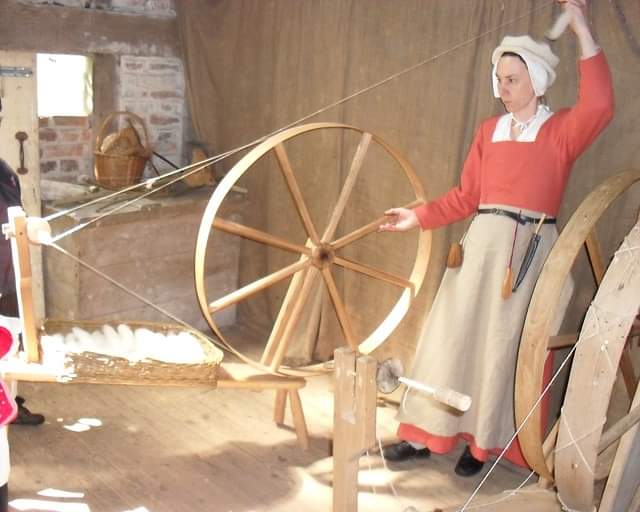
In the medieval towns and villages of Europe, one could often spot groups of unmarried women gathered together, focused intently on the rhythmic twisting of fibers into yarn. These were the spinsters - skilled textile workers whose strategic contribution to the medieval economy belied their humble unmarried status. 

The word "spinster" originated in the late Middle Ages, quite literally referring to women who spun fiber into thread and yarn as their profession. At a time when respectable labor for females was limited, spinning allowed urban and rural unmarried women to earn a relatively independent living.

From dawn until dusk, the cadences of spinning wheels provided the soundtrack to daily life. Using wooden drop spindles or tensioned treadle wheels, spinsters would dexterously draw out strands of wool, flax, cotton or silk, applying a twisting motion to bind the fibers into strong, uniform yarn. The degree of consistency in the threading created superior quality textiles suitable for weaving into clothing, hangings and other goods.

What may have began as a casual cottage industry blossomed into a far more professionalized trade by the 15th century, as the outputs of urban spinster guilds supplied the voracious demand of commercial cloth production. The term "spinster" evolved to indicate a woman's legal status as unmarried - on tax rolls, censuses and contracts, her occupation was officially listed as such.

Despite their upright reputations as tradeswomen, Medieval society carried disdainful attitudes towards spinsters that persisted for centuries. As women who had rejected or been rejected from the conventional paths of marriage and family life, they were often branded as "odd" or "unnatural" on the fringes of polite society. Marginalized economically and socially, many spinsters still managed to enjoy lives of relative independence while contributing to the production of vital goods.

In both literature and art of the era, spinsters appear frequently - sometimes emblematic of industrious virtue, sometimes ridiculed as unconventional outsiders. Chaucer's 14th century Canterbury Tales featured a capable wife who "...could scratch well cards and spin." Artworks show peasant women spinning in the field while others depict aristocratic ladies spinning for piety and leisure.

What is undeniable is the elemental role these working fiber artists played in provisioning medieval Europe with the basic textiles required for clothing the population and handling the considerable domestic needs of castles and manors. Every shirt, tunic or tapestry owed a debt of gratitude to the nimble hands and experienced techniques of the modestly titled yet invaluable spinster.

While romantic love may have eluded them, these single women collectively adored their handicraft. The spinning wheel, a deceptively simple piece of equipment, unlocked a world of self-sufficiency in a deeply patriarchal era. Under the treadle lay an opportunity for financial autonomy and a sense of occupational pride seldom experienced by most females. In the fibers they so deftly manipulated were interwoven the threads of economic security for enterprising medieval women.

So as we look back on this period where identity and status were so entwined with one's labor, the unsung spinster emerges as a truly skilled artisan - and one of the enduring emblems of unmarried female self-reliance. Her double-threaded legacy lives on in the enriched textiles she created and the socioeconomic impact of her unheralded yet indispensable occupation.

Sources:

https://www.merriam-webster.com/

https://getthespecialists.co.uk


Sword Defense, Fencing, and the Art of the Blade in Colonial America

  Steel and Honor Sword Defense, Fencing, and the Art of the Blade in Colonial America and the American Revolutionary War Period (1620–1...