In the medieval towns and villages of Europe, one could often spot groups of unmarried women gathered together, focused intently on the rhythmic twisting of fibers into yarn. These were the spinsters - skilled textile workers whose strategic contribution to the medieval economy belied their humble unmarried status.
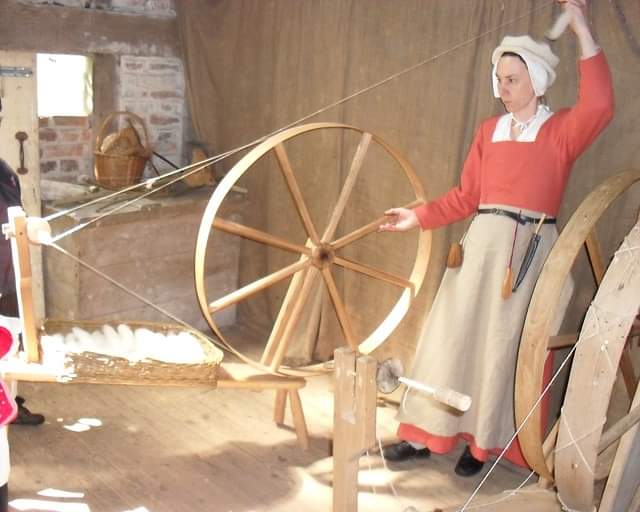
The
word "spinster" originated in the late Middle Ages, quite literally
referring to women who spun fiber into thread and yarn as their
profession. At a time when respectable labor for females was limited,
spinning allowed urban and rural unmarried women to earn a relatively
independent living.
From dawn until dusk, the cadences of
spinning wheels provided the soundtrack to daily life. Using wooden drop
spindles or tensioned treadle wheels, spinsters would dexterously draw
out strands of wool, flax, cotton or silk, applying a twisting motion to
bind the fibers into strong, uniform yarn. The degree of consistency in
the threading created superior quality textiles suitable for weaving
into clothing, hangings and other goods.
What may have began as a
casual cottage industry blossomed into a far more professionalized
trade by the 15th century, as the outputs of urban spinster guilds
supplied the voracious demand of commercial cloth production. The term
"spinster" evolved to indicate a woman's legal status as unmarried - on
tax rolls, censuses and contracts, her occupation was officially listed
as such.
Despite their upright reputations as tradeswomen,
Medieval society carried disdainful attitudes towards spinsters that
persisted for centuries. As women who had rejected or been rejected from
the conventional paths of marriage and family life, they were often
branded as "odd" or "unnatural" on the fringes of polite society.
Marginalized economically and socially, many spinsters still managed to
enjoy lives of relative independence while contributing to the
production of vital goods.
In both literature and art of the era,
spinsters appear frequently - sometimes emblematic of industrious
virtue, sometimes ridiculed as unconventional outsiders. Chaucer's 14th
century Canterbury Tales featured a capable wife who "...could scratch
well cards and spin." Artworks show peasant women spinning in the field
while others depict aristocratic ladies spinning for piety and leisure.
What
is undeniable is the elemental role these working fiber artists played
in provisioning medieval Europe with the basic textiles required for
clothing the population and handling the considerable domestic needs of
castles and manors. Every shirt, tunic or tapestry owed a debt of
gratitude to the nimble hands and experienced techniques of the modestly
titled yet invaluable spinster.
While romantic love may have
eluded them, these single women collectively adored their handicraft.
The spinning wheel, a deceptively simple piece of equipment, unlocked a
world of self-sufficiency in a deeply patriarchal era. Under the treadle
lay an opportunity for financial autonomy and a sense of occupational
pride seldom experienced by most females. In the fibers they so deftly
manipulated were interwoven the threads of economic security for
enterprising medieval women.
So as we look back on this period
where identity and status were so entwined with one's labor, the unsung
spinster emerges as a truly skilled artisan - and one of the enduring
emblems of unmarried female self-reliance. Her double-threaded legacy
lives on in the enriched textiles she created and the socioeconomic
impact of her unheralded yet indispensable occupation.
Sources:
https://www.merriam-webster.com/
https://getthespecialists.co.uk


No comments:
Post a Comment